Have you ever sat down to check a single work email—only to blink and realize you’ve spent forty-five minutes watching a “Day in the Life” vlog of someone living in a converted school bus in Oregon?
Don’t worry. You’re not broken.
In 2026, we’re living at the peak of the Attention Economy. Your focus has become one of the most valuable resources on the planet. Every app on your phone is a billion-dollar machine engineered to keep you scrolling instead of thinking.
And here’s the uncomfortable truth:
Living with purpose isn’t about discovering a dramatic destiny. It’s about the quiet, intentional choices you make when the world is screaming for your attention.
The Modern Fog: Why We Feel So Lost
Before we can reclaim purpose, we need to understand what’s stealing it.
Researchers describe our mental state as Continuous Partial Attention (CPA)—we’re always “on,” but rarely present.
We spend our days reacting:
Notifications
Messages
Breaking news
Algorithmic content
The result? A state of constant motion with no direction.
We confuse busy-ness with progress. But being busy often means we’re distracted in socially acceptable ways. We’re doing a lot—yet going nowhere.
The Hidden Cost of Attention Residue
Every time you switch from meaningful work to check a “quick” notification, your brain pays a tax.
Psychologists call this attention residue.
Even after you put your phone down, part of your mind stays stuck on:
That message you didn’t reply to
That headline you half-read
That comment you can’t forget
Studies show it can take up to 23 minutes to fully regain deep focus after a single interruption.
Multiply that by dozens of interruptions per day—and suddenly it’s clear why so many people feel exhausted, unfocused, and disconnected from purpose.
What Does “Living with Purpose” Actually Mean?
Many people mistake purpose for a job title or a long-term plan.
In reality, purpose is less about what you do—and more about why and how you do it.
Living with purpose means:
Aligning daily actions with core values
Using your strengths in meaningful ways
Contributing to something beyond yourself
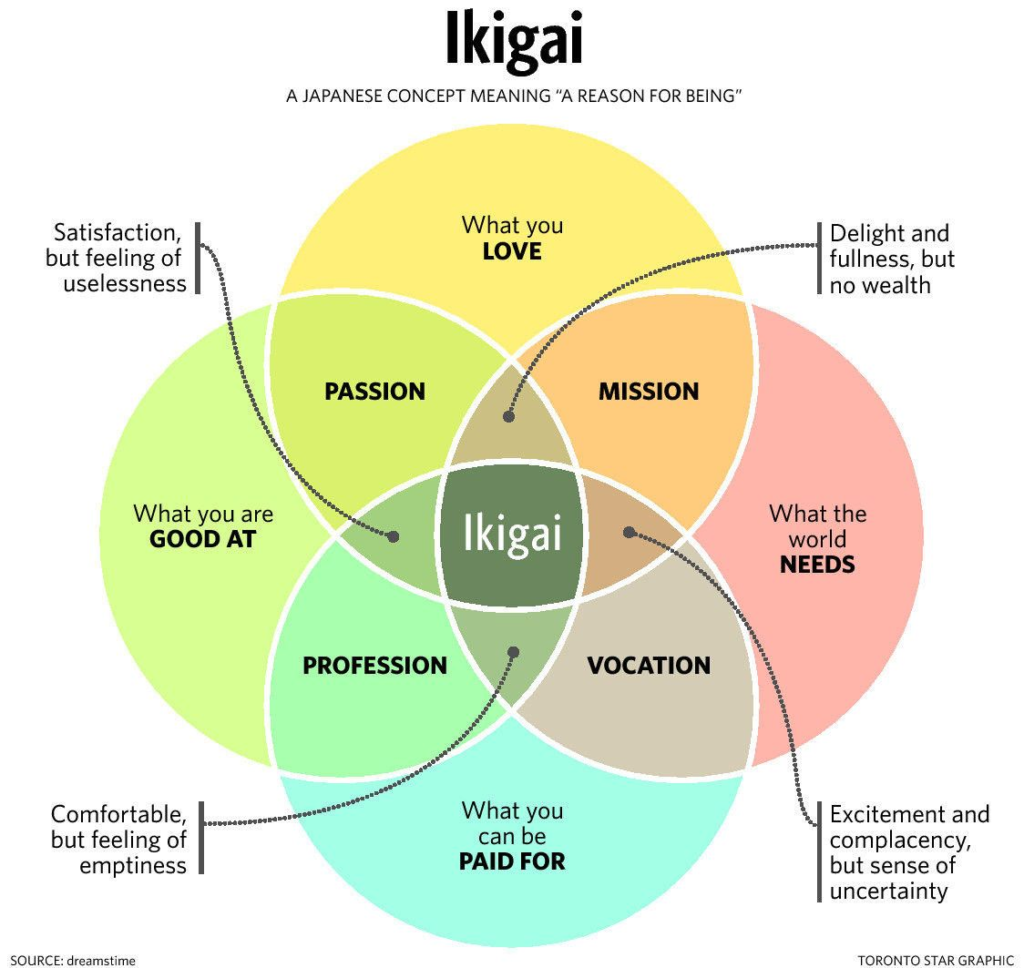
A powerful way to visualize this is the Japanese concept of Ikigai.
When what you:
Love
Are good at
Are needed for
Can be rewarded for
…overlap, you find your reason for being.
In a distracted world, Ikigai becomes a compass. When you know your why, it becomes far easier to say no to digital noise that doesn’t serve your life.
5 Practical Steps to Reclaim Your Purpose
If you feel like you’re running endlessly on a digital treadmill, it’s time to step off.
1. Conduct an “Attention Audit”
You can’t manage what you don’t measure.
For one week, track:
Where your time actually goes
Which apps drain energy vs. create value
The Fix: Use your phone’s screen-time tools. Set hard limits. Delete one non-essential app for seven days and observe—do you miss it, or do you breathe easier?
2. Build Boredom Tolerance
We’ve become terrified of silence.
The moment there’s a pause—an elevator ride, a red light, a coffee line—we reach for stimulation. This erodes our ability to think deeply.
The Fix: Practice productive boredom. Let your mind wander. This is often where clarity, insight, and purpose quietly emerge.
3. Prioritize Deep Work Over Shallow Pings
Author Cal Newport popularized the idea of Deep Work—focused, distraction-free effort that creates real value.
The Fix: Schedule 90-minute Deep Work blocks early in the day—before checking email or messages. Treat that time like a million-dollar meeting—because for your future self, it is.
4. Shift from Consumer to Creator
One reason purpose feels distant is simple:
We consume far more than we create.
The Fix: Adopt a 1-for-1 rule:
For every hour of consumption, spend one hour creating.
Creation could be:
Writing
Building
Gardening
Coding
Cooking
Creation grounds you in reality. Consumption pulls you into comparison.
5. Embrace Slow Living – On Purpose
In 2026, fast is the default.
Purpose lives in the moments where you intentionally slow down.
The Fix: Choose one daily activity to do without technology:
Morning coffee
Walking the dog
Eating lunch
No music. No scrolling. Just presence.
The Real Reward: A Life of Intentionality
Living with purpose doesn’t mean you’ll never get distracted again.
You will. You’re human.
But when you have a clear sense of purpose, you always have a home base to return to.
You stop being a leaf blown around by algorithms—and start becoming the pilot of your own life.
The result?
More energy
Less burnout
Deeper satisfaction
The world is engineered to distract you. Choosing to focus is a quiet act of rebellion.
Final Reflection
Which of these five steps will you try today?
Even a 10-minute no-phone walk can change the tone of your entire afternoon.
If you’d like, I can:
Create a printable Attention Audit template
Design a Daily Purpose Planner
Or turn this into a short-form post series (LinkedIn, Medium, Substack)
Have you ever stared at a blank screen and felt your brain suddenly go… quiet? The cursor blinks like a metronome. Your ideas feel trapped behind glass.
For decades, creators faced the blank canvas alone. But in 2026, the canvas isn’t empty—it’s alive. It hums with algorithms, AI assistants, editing tools, recommendation systems, and collaboration platforms that are quietly rewriting how imagination works.
So what’s really happening to creativity?
Technology is doing two things at once:
Expanding what’s possible
Increasing the noise you have to fight through
Let’s break down the biggest shifts.
1. The Fall of the Gatekeeper
Not long ago, creative success often depended on permission.
You needed:
a label to distribute music
a publisher to print your words
a gallery to validate your art
a big budget to produce “professional” work
Today, the barrier hasn’t disappeared—but it has collapsed dramatically.
A teenager with a phone can shoot, edit, color-grade, and publish work that would have required a studio team a decade ago. And because distribution is built-in, good ideas can travel without an invitation.
That doesn’t guarantee attention—but it does change the game: creativity becomes less about access and more about originality + consistency.
2. AI as Your Creative Co-Pilot (Not Your Replacement)
We used to treat computers like calculators. Now we use them like collaborators.
When you prompt an AI for logo variations, story arcs, video hooks, or chord progressions, you’re not outsourcing creativity—you’re playing creative ping-pong.
Where AI helps most
Lightning-fast iteration: explore 30–50 options in minutes
Pattern-breaking suggestions: ideas outside your habitual style
AI boosts volume. Humans provide direction. AI can generate a hundred doors. Your job is choosing which one matters.
3. Creativity in New Dimensions (VR, AR, Spatial Computing)
Most of human creativity has been constrained by flat surfaces: paper, canvas, screens, frames.
Now the medium itself is changing.
In VR/AR, you can:
sculpt where gravity doesn’t exist
design rooms you can physically “walk through” before building them
place sound around a listener instead of in stereo lines
This is more than a new tool—it’s a new type of imagination.
We’re moving from: looking at the work → being inside the work
And once that becomes normal, entire art forms will appear that don’t even have names yet.
4. The Global Brain: Cloud Collaboration as a Creative Engine
Creativity used to be lonely—or local.
Now it’s networked.
A designer in London, a developer in Tokyo, and a writer in New York can build something together in real time. Ideas get cross-pollinated instantly, and that’s why we’re seeing the rise of hybrid styles:
traditional art + generative visuals
local storytelling + global meme language
handcrafted brands + digital-native aesthetics
The creative “studio” is no longer a place. It’s a shared workspace + shared taste.
5. The Algorithmic Trap (The Price of Convenience)
Here’s the shadow side: most platforms reward what’s already working.
Algorithms optimize for:
familiarity
retention
predictability
trend replication
That can create a subtle sameness—where creators unconsciously aim for what gets clicks instead of what feels true.
So the modern creative challenge isn’t “How do I use technology?”
It’s: How do I use technology without being shaped by it?
A simple rule that helps:
Use algorithms for distribution
Protect your originality with intentional weirdness
make things that don’t fit neatly
publish imperfect experiments
create offline sometimes
6. The Rise of the Human Premium
The more content AI produces, the more valuable human signals become.
Have you ever been fine all day… then one tiny comment flips a switch?
Suddenly you’re replaying a moment from five years ago, building imaginary arguments in the shower, and wondering, Why am I like this? That’s the strange thing about being human: we live inside our minds nonstop, yet rarely understand what’s running the show.
The truth is, your thoughts aren’t random sparks. They’re more like weather shaped by biology, survival wiring, and the environment you’ve lived in.
Let’s open the hood.
1. The Biological Blueprint
At the most basic level, thinking is physical. Your brain is a living network of billions of neurons, constantly exchanging electrical signals and chemicals.
Neurotransmitters: the “mood lighting” of thought
Chemicals like dopamine (motivation/reward), serotonin (mood stability), and cortisol (stress response) influence what your mind pays attention to.
When stress is high, your brain tends to scan for danger—so your thoughts often skew toward:
worst-case scenarios
rejection sensitivity
“what if everything goes wrong?”
Not because you’re broken. Because your nervous system is doing its job.
Neural pathways: the forest-trail effect
Imagine your mind as a forest. Each repeated thought is a path. The more you walk it, the easier it becomes to default to it.
That’s why:
habits feel automatic
mindsets feel “true”
the same worries come back on schedule
Your brain likes efficiency—even when the route isn’t helpful.
2. Your Mind Was Built for Survival, Not Happiness
Our ancestors didn’t survive by being calm and reflective. They survived by being alert.
That leaves modern humans with a few built-in tendencies:
Negativity bias
Bad news sticks harder than good news. A compliment can fade in minutes; a criticism can echo for days.
Pattern recognition (and misfires)
Your brain is a meaning-making machine. It finds patterns fast because that’s useful.
But it also means we sometimes:
see threats where there aren’t any
assume intent (“they disrespected me”)
connect dots that don’t belong together
This is where cognitive biases sneak in: not as flaws, but as shortcuts that sometimes backfire.
3. Culture and Upbringing: Your Invisible Mental Software
You aren’t only shaped by your brain you’re shaped by the world that trained it.
Here are three powerful “invisible” influences:
Influence Factor
How it Shapes Thought
Language
What you can name, you can notice. The words you have shape the feelings you can identify and regulate.
Core Beliefs
Early “truths” become filters: what you think you deserve, what love means, what danger looks like.
Social Proof
We often adopt the beliefs of our tribe – because belonging has always been a form of safety.
Even your inner voice has a history. Sometimes it’s not “you” talking – it’s an old environment still running in the background.
4. Neuroplasticity: The Best News About Your Brain
Here’s the hopeful part: your mind is not a fixed personality trait.
Because of neuroplasticity, the brain can rewire based on repeated attention and practice. In plain terms:
What you repeatedly rehearse, you reinforce. What you repeatedly interrupt, you weaken.
This is why things like mindfulness, CBT-style reframing, journaling, and skill-building can genuinely change your mental defaults.
A Practical Tool: Break the Thought Loop in 60 Seconds
Next time you catch a loop, try this:
Name it: “This is worry.” / “This is rejection fear.” / “This is rumination.”
Locate it: Where is it in the body—tight chest, jaw, stomach?
Narrow it: What is the one sentence story your brain is repeating?
Shift one degree: Ask: What’s another plausible interpretation?
Not “everything is fine,” but “I don’t have enough info yet.”
Small shifts repeated consistently become new paths in the forest.
“The mind is its own place, and in itself can make a heaven of hell, a hell of heaven.” — John Milton
The Bottom Line
We think the way we do because our modern lives are running on ancient wiring—shaped by chemistry, survival instincts, and the environments that formed us.
You may not control the first thought. But you can train what happens next.
Takeaway (try this today)
For one day, don’t fight your thoughts study them:
What triggers them?
What story do they tell?
What do they try to protect you from?
Reflection question: If your recurring thought loop had a job title what would it be trying to do for you?
“You want change without sacrifice. You want peace without struggle. The world doesn’t work like that.”
The Comfort Illusion
We crave transformation but on our terms. We want to evolve, but we don’t want to hurt. We want to grow, but we resist the grind that growth demands.
It’s a paradox of our age: we want the fruit without planting the seed, the reward without the risk, the strength without the strain.
We scroll through success stories and whisper to ourselves, I want that. But we rarely ask, Am I willing to pay for it?
Because every genuine transformation every deep, lasting change comes with a cost. And the price is often higher than comfort is willing to pay.
The Hidden Economy of Life
Everything meaningful in life operates within an unseen economy a law of exchange that governs all growth.
To gain, something must be given. To rise, something must fall away. To find peace, you must first make peace with struggle.
Life demands balance. The universe is not cruel, it’s precise. It gives you what you earn, not what you wish for.
You cannot negotiate with gravity, and you cannot bargain with growth. If you want a new life, you must be ready to let the old one burn.
The Fire of Transformation
Every human life has seasons of burning periods when the structures we’ve built begin to collapse, when the routines that once felt safe suddenly feel suffocating.
These are not moments of punishment; they are moments of purification.
A forest fire looks like destruction but beneath the ashes, the soil becomes rich again. The old growth must die for the new to rise.
The same is true for us. To evolve, we must release what no longer serves us:
The comfort that keeps us stagnant.
The beliefs that limit our potential.
The fears that keep us small.
The fire hurts, yes but it also reveals who we truly are.
The Struggle as Teacher
We’ve been conditioned to see struggle as something to avoid, as a flaw in the system of life. But what if struggle isn’t the obstacle what if it’s the curriculum?
Every trial teaches resilience. Every heartbreak teaches depth. Every failure refines humility and direction.
The most grounded people you know the ones with calm energy and quiet strength have not lived easy lives. They’ve simply learned to suffer well.
They’ve stopped resisting the lessons of pain and started listening to them. They understand that peace is not the opposite of struggle it’s the outcome of understanding it.
The Psychology of Sacrifice
Sacrifice is often misunderstood. It’s not about loss. It’s about making a choice.
It’s giving up something good for something greater. It’s postponing immediate gratification for long-term fulfillment. It’s aligning your actions with the future you claim to want.
In psychology, this is called cognitive alignment when what you believe, what you say, and what you do all match. Until that alignment exists, you’ll always feel inner conflict the tension of wanting peace while feeding chaos.
The real sacrifice, then, isn’t just in giving up pleasures it’s in giving up contradictions. It’s the decision to live with integrity, even when it hurts.
The Weight of Peace
People often say they “just want peace.” But peace isn’t passive. It’s heavy.
It requires boundaries. Honesty. Discipline. It demands that you stop running from the things that disturb you and start confronting them.
True peace doesn’t come from meditation retreats or quiet mornings it comes from integration. When your mind, emotions, and actions are no longer at war with each other, silence follows naturally.
And that silence that unshakable calm can only emerge after you’ve faced the noise.
The Resistance Within
The greatest battle is always internal. It’s not against other people, or the world, or fate it’s against the part of yourself that clings to comfort.
That part that whispers: Not yet. Maybe later. It shouldn’t be this hard.
But change is hard and that’s precisely why it matters. If it were easy, everyone would live fulfilled, peaceful lives. But the few who do are the ones who stopped resisting discomfort and started using it.
They turned fear into fuel. Pain into perspective. Sacrifice into strength.
The Long Road to Real Change
Most people want quick transformation a clean story arc from problem to solution. But growth isn’t cinematic; it’s slow, nonlinear, and messy.
It’s the quiet grind of repetition. It’s choosing discipline on the days you feel uninspired. It’s standing back up after failure, again and again, until something inside you shifts for good.
Change doesn’t arrive with trumpets; it sneaks in through small, consistent choices often invisible to everyone else. And one day, without realizing when it happened, you become someone stronger, calmer, and wiser than before.
That’s the true reward for sacrifice: identity. You don’t just get new results you become a new person.
The World Doesn’t Work Like That and That’s the Point
The world isn’t built to hand you ease. It’s built to invite you into evolution.
Every challenge is a signal. Every struggle is a shaping. Every sacrifice is an offering to the person you’re becoming.
The moment you stop asking for things to be easier and instead start asking to be stronger everything changes.
Because life was never meant to be effortless. It was meant to be meaningful. And meaning only emerges when we give something of ourselves away.
Closing Reflection
You want change without sacrifice. You want peace without struggle. The world doesn’t work like that and thank God it doesn’t.
Because if it did, we’d never become anything. We’d never find out how strong, how capable, how infinite we can be.
So let the struggle shape you. Let the sacrifice purify you. And let the discomfort remind you you’re alive, you’re growing, and you’re on the path.
Ask yourself: What pain am I avoiding that might actually be my path to peace? And what am I willing to let go of to finally become who I’m meant to be?
In a world flooded with noise and distraction, clear thinking has quietly become a superpower.
Every day, you make hundreds of decisions what to prioritize, how to respond, whether to take a risk or play it safe. Most people rely on instinct or emotion. The best thinkers, however, rely on mental models structured ways of interpreting reality that simplify complexity and sharpen judgment.
This article explores eight mental models that can dramatically improve your clarity, productivity, and ability to make good decisions.
What Are Mental Models?
A mental model is a framework for understanding how the world works. It’s a concept or principle you can use repeatedly to interpret new situations.
Think of your brain as a toolbox. Each model is a different tool you can reach for depending on the problem you’re trying to solve. When you build a collection of these tools, you begin to see recurring patterns and those patterns give you leverage over confusion and uncertainty.
As Charlie Munger once said:
“Develop a latticework of mental models. The more models you have, the better your ability to think broadly.”
1. Parkinson’s Law: Work Expands to Fill the Time
“If you have ten days to finish a project, it will take ten days even if it could have been done in five.”
This law explains why many people are busy but rarely productive. When time feels abundant, attention dilutes and momentum fades. The antidote is deliberate constraint: intentionally shorten your deadlines.
Give yourself half the time you think you need. You’ll find your mind becomes sharper, your focus cleaner, and your output faster.
Use it in: productivity, time management, and creative work.
2. Sturgeon’s Law: 90% of Everything is Mediocre
Science fiction writer Theodore Sturgeon once said, “Ninety percent of everything is crap.”
Once you accept that, you stop trying to consume or produce everything and instead focus on the small percentage that truly matters.
Most ideas, books, and content add little value. But within that remaining ten percent lies the gold the signal among the noise.
Use it in: curation, creativity, and strategy. Learn to filter aggressively and value quality over volume.
3. The Eisenhower Matrix: Urgent vs. Important
President Dwight Eisenhower famously said:
“What is important is seldom urgent, and what is urgent is seldom important.”
He designed a simple 2×2 matrix to help distinguish between urgency and importance:
Urgent
Not Urgent
Important
Do it now
Schedule it
Not Important
Delegate it
Eliminate it
Most of us spend our days in the top-left quadrant reacting to what’s urgent. Real progress happens in the top-right quadrant, focusing on important but not urgent work like planning, learning, and building.
Use it in: prioritization, leadership, and personal organization.
4. Second-Order Thinking: Look Beyond the Immediate
First-order thinking asks, “What happens next?” Second-order thinking asks, “And what happens after that?”
Every action has consequences and those consequences have further consequences. Thinking two or three steps ahead prevents shortsighted decisions.
Example: You’re offered a high-paying job. First-order thinking says, “That’s great.” Second-order thinking asks, “Will this make me happier, or will I trade freedom for money?” “What long-term habits will this create?”
Use it in: strategy, investing, and long-term decision-making.
5. The Pareto Principle: The 80/20 Rule
In most systems, a small percentage of causes drive the majority of results. Roughly 80% of outcomes come from 20% of actions.
Identify which 20% creates disproportionate impact and focus there relentlessly.
20% of customers drive 80% of sales.
20% of exercises deliver 80% of fitness gains.
20% of habits shape 80% of your results.
Use it in: productivity, business, and personal growth. Audit regularly and double down on what truly matters.
6. The Regret Minimization Framework: Think Like Your Future Self
When Jeff Bezos considered leaving his stable job to start Amazon, he imagined himself at age eighty and asked:
“Will I regret not doing this?”
By using his future self as a guide, he shifted from fear-based decision-making to values-based decision-making.
Whenever you face uncertainty, ask yourself: “What would my older self wish I had done?” This lens brings clarity when logic and emotion conflict.
Use it in: major life decisions, risk-taking, and goal setting.
7. Avoid the Path of Least Resistance: Growth Lives in Challenge
Humans are wired to conserve energy. We naturally choose the easiest path. But growth never happens in comfort.
If something feels too easy, you’re probably not learning. Real progress lives on the edge of discomfort where effort meets resistance.
You don’t have to seek pain, but you should embrace challenge as a signal of growth.
Use it in: fitness, learning, entrepreneurship, and resilience-building.
8. The Dunning-Kruger Effect: The Confidence Curve
The least skilled people often overestimate their abilities, while true experts underestimate theirs. This cognitive bias reminds us that confidence and competence don’t grow at the same rate.
Awareness of this effect keeps you humble when learning and grounded when succeeding. When you’re new to something, remember that you might not know what you don’t know. When you’re experienced, remember that even mastery has blind spots.
Use it in: leadership, teaching, and emotional intelligence.
Building Your Latticework of Thought
Each mental model is powerful on its own, but the real strength comes when you combine them building a latticework of ideas that reinforce one another.
Over time, this network becomes your mental operating system: a way of seeing patterns others miss, and of thinking clearly when others react impulsively.
Smart people don’t just know what to think they know how to think.
Final Thoughts
Mental models aren’t abstract theories. They are practical tools for better judgment and clearer decision-making. Start by choosing one or two from this list and applying them in your daily life.
Soon you’ll notice a shift: you’ll think with more clarity, decide with more confidence, and see connections that were invisible before.